
Blog

You can spend three days in San Diego and still miss much of what gives the city its character.
The zoo, the harbor cruise, and the Gaslamp belong on many first visits. They are not the whole city. Under freeway ramps, along unstable coastal bluffs, and between residential streets are places that reveal how San Diego’s neighborhoods, landscape, and residents shaped it. Here is the version of this city most itineraries skip.
Chicano Park hides beneath the Coronado Bridge approach ramps in Barrio Logan, which is why most people drive over it and never look down.
From above, concrete. From underneath, one of the largest and most culturally significant collections of Chicano murals in the United States.
On the pillars: dozens of monumental murals across roughly seven acres. Cesar Chavez. Frida Kahlo. Aztec cosmology. Scenes from the neighborhood’s own history, painted by people who lived it.
The pillars create the scale of a cathedral, but the space stays unmistakably public: traffic overhead, neighborhood life around it.
Sunset Cliffs Natural Park stretches 68 acres along the western edge of Point Loma, free year-round. The layered bluffs erode under wave action, runoff, and weather, and that erosion is what carves the sea caves and arches.
What most guides gloss over: these cliffs actively fall into the ocean. A section near the natural arch collapsed in April 2026. The fencing is not decorative, and the ground that looks solid is the ground currently eroding.
Cabrillo National Monument occupies the southern end of Point Loma, the National Park Service site within the City of San Diego. It pairs with Sunset Cliffs in a single half-day, though the ride between them takes longer than the map suggests.
The view faces east toward downtown, with the bay throwing the city back at you. Below the visitor center, tide pools fill a protected zone where low tide may reveal anemones, urchins, crabs, and other intertidal life.
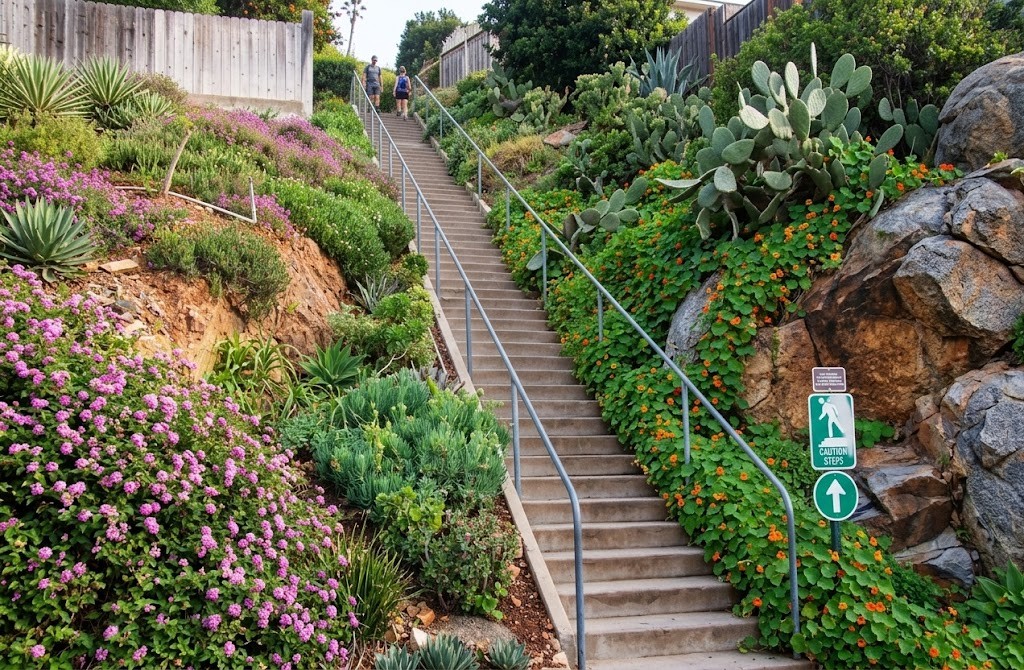
This stop is unusual for an itinerary because it is not a public garden or formal attraction. It is the street-facing yard of a private home.
The Harpers transformed the slope below their home into a collection of more than 50 hand-shaped plant figures. Following Edna Harper’s passing in 2026, the garden’s long-term preservation and ownership status may change, so confirm current viewing conditions before making a special trip.
Nice to know: There are no public visiting hours. View it quietly from the sidewalk during normal daylight hours, obey all posted signs, and do not enter the property.
A 375-foot pedestrian suspension bridge over Kate Sessions Canyon in Banker’s Hill, held by steel cables and hidden in the treetops between two ordinary residential streets.
It sways. Not considerably, but enough that first-timers slow down halfway. From the middle, the canopy hides the street below, which is the appeal: a pocket of quiet three minutes from downtown. Locals use it as a shortcut. Most visitors never learn it exists.
Worth knowing: free, generally open 6 AM to 10 PM, though check posted signs. Street access at Spruce Street and First Avenue. From the western side of Balboa Park, the walk may take roughly 30–45 minutes depending on the starting point and route.
These split into three clusters.
Doing all three in one day is tight. Point Loma and Barrio Logan face each other across the bay, and afternoon traffic through downtown costs more than the map admits.
None of these connect on a single transit line, which makes the order you visit them the whole plan.
A little planning matters more here than for a standard itinerary, because Sunset Cliffs depends on daylight and tides, while Cabrillo’s coastal areas close before the monument itself.
These five places do not share one type of admission, ownership, or experience. What connects them is that each reveals something about how San Diego became the city it is.
Chicano Park records a neighborhood’s fight for public space. Sunset Cliffs shows that the coast is still changing beneath visitors’ feet. Cabrillo protects both national history and a vulnerable intertidal environment. Harper’s garden turns a private slope into something strangers can enjoy from the sidewalk, while the Spruce Street Bridge makes an ordinary neighborhood crossing memorable.
The familiar attractions can fill an enjoyable first visit. These places add context. Give them time, follow the rules that protect them, and San Diego starts to feel less like a collection of stops and more like a city you understand.
Share this: